Understanding these massive servings is key. We’ll dive into why these big portions exist. We will also look at what they mean for us as consumers.
You’ll learn how to spot them and what to consider when ordering.
The biggest fast food portions often come from a focus on perceived value and customer demand for more food. Restaurants aim to make you feel like you’re getting a lot for your money. This means offering larger sizes for drinks, fries, and main dishes, sometimes without a huge price jump.
The Rise of the Mega-Portion
Fast food started small. Early menus had simpler options. Think of a standard hamburger, a small order of fries, and a regular soda.
These were the norm for decades. People ate them and were satisfied.
But over time, things changed. Restaurants saw that offering a “large” or “extra-large” size could sell more. Customers often chose the bigger option, especially if the price difference was small.
This led to a cycle of increasing portion sizes.
This trend didn’t happen overnight. It built up slowly. Brands noticed what worked. They started advertising bigger and better deals.
The idea of getting “more for your money” became a powerful selling point. We saw the birth of the “Super-Sized” meal, for example. This was a clear signal that bigger was better.
What we consider a “normal” portion today is often much larger than what was considered normal 20 or 30 years ago. This shift affects not just the main course but also sides and drinks. It’s a complete change in how fast food is served.
Why Are Portions So Big Now?
Several things pushed fast food portions to grow. One big reason is competition. Restaurants need to stand out.
Offering a massive burger or an overflowing bucket of fries can catch your eye. It makes them seem like a better deal than a smaller meal elsewhere.
Another factor is consumer behavior. Many people think that paying a bit more for a much larger serving is a smart choice. They want to feel like they are getting their money’s worth.
This desire for value drives the demand for bigger sizes.
Think about it: if two meals cost almost the same, but one is twice the size, most people will pick the larger one. This sends a clear message to the restaurants. They learn that bigger sells.
So, they keep making their offerings bigger.
Economic factors also play a role. The cost of ingredients can fluctuate. Sometimes, offering more food at a slightly higher price is more profitable than raising prices significantly on smaller portions.
It can seem like a win-win for the restaurant and the customer.
The History of “Supersizing”
The concept of “supersizing” became famous in the late 1990s and early 2000s. A specific fast-food chain made it a central part of its marketing. They offered to upgrade your fries and drink to a much larger size for a small extra cost.
This marketing strategy was incredibly successful. It tapped into the public’s desire for more food for less money. People started ordering supersized meals as a matter of course.
It became a cultural phenomenon, even inspiring movies and discussions about health.
This era really solidified the idea that “more is better” in the fast-food world. It showed that portion size could be a major selling point. While the direct “Supersize Me” era has passed, the lessons learned continue to influence portion sizes today.
Fast Food Portion Evolution: A Quick Look
Early Days (1950s-1970s): Standard sizes. A burger was a burger. Fries came in modest paper bags.
Drinks were in small cups.
The “Value” Era (1980s-1990s): “Value meals” and larger options appeared. Combo meals became popular, with options for larger fries or drinks.
The Supersize Boom (Late 1990s-2000s): Explicit “supersizing” options. Huge drinks and fries became a highlight.
Modern Era (2010s-Present): Even bigger options, often unnamed. “Family sizes” and “sharing platters” even for individual items. New menu items often launch with enormous versions.
The influence of those supersized years is still felt. Restaurants learned that bigger portions could drive sales. They found ways to offer them that felt like a good deal to the customer.
This has led to the massive servings we see everywhere today.
What Are the Biggest Fast Food Portions?
It’s tough to name one single “biggest” portion. Fast food chains are always innovating. They introduce limited-time offers and new menu items.
These often come with impressive, large sizes. But some categories consistently feature huge servings.
Drinks are a prime example. Many fast-food places offer drinks that are 32 ounces, 44 ounces, or even larger. These are much bigger than a typical glass of water at home.
Some places have drink sizes that could easily serve two or three people.
Fries are another category where portions have ballooned. What used to be a small or medium order can now be a “large” that feeds a small group. Some places offer “family-sized” buckets of fries that are truly enormous.
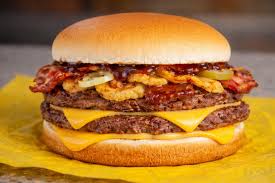
Burgers have also grown. While the standard cheeseburger is still around, many chains now offer double, triple, or even quadruple patty burgers. These are stacked high with meat, cheese, and toppings.
Some are designed to be shared but are often ordered by individuals.
Chicken offerings can also be massive. Think of buckets of fried chicken or large family-sized servings of chicken tenders. These are designed for groups but can easily be consumed by one hungry person.
The key is that these large portions are often available as standard or as an upsell. You might not even realize how big you’re ordering until the food arrives. It’s easy to end up with a serving that’s far more than you intended to eat.
My Experience with Huge Servings
I remember one time I was really craving a specific fast-food chicken sandwich. I hadn’t had it in ages. I ordered it online and, without really thinking, chose the “large” combo.
The website showed a picture of a sandwich, fries, and a drink. It looked good.
When my order arrived, I was stunned. The drink cup was enormous, easily a 32-ounce behemoth. The box of fries was overflowing.
I could barely fit it on my small kitchen table. The sandwich itself was a decent size, but the sides were just… a lot. I felt a mix of excitement and dread.
It was more food than I could realistically eat in one sitting.
I ended up eating the sandwich and a small portion of fries. The rest of the fries sat there, a tempting but overwhelming pile. I felt guilty throwing them away, but I knew I couldn’t eat them.
It was a moment where the sheer scale of the portion hit me. It wasn’t just food; it was an almost absurd amount of food for one person.
Portion Sizes: A Quick Comparison (Approximate US Standard vs. Large Fast Food)
Fries:
- Standard Small (home serving): 3-4 oz
- Fast Food Medium: 4-5 oz
- Fast Food Large: 6-8 oz
- Fast Food Extra Large/Family: 10-16+ oz
Soda:
- Standard Glass (home): 8-12 oz
- Fast Food Small: 16-20 oz
- Fast Food Medium: 22-24 oz
- Fast Food Large: 32-44+ oz
That experience made me more mindful. I started looking at the sizes more closely. I realized that the “large” I used to order without a second thought was actually a massive amount of food.
It’s easy to fall into the habit of just ordering the biggest size because it’s there.
The Psychology Behind Big Portions
There’s a lot of thought that goes into why fast food portions are so big. It’s not an accident. Restaurants understand how our minds work when it comes to food and money.
One key idea is the “delusion of value.” When you see a huge portion, your brain often interprets it as a great deal. You might think, “Wow, look at all this food for only $X!” You focus on the quantity, not necessarily the quality or your actual needs.
Restaurants also use menu engineering. They strategically price larger sizes. Often, the price increase from a medium to a large is small.
This makes the large size seem like the logical choice. It’s a form of psychological pricing.
Think about the visual presentation. A large drink cup looks impressive. A big bag of fries seems abundant.
These visual cues enhance the feeling of getting a lot for your money. The sheer size is part of the appeal.
Furthermore, social norms play a part. If everyone around you is ordering large drinks and supersized meals, you’re more likely to do the same. It becomes the standard way of eating fast food.
Finally, convenience and hunger are huge factors. When you’re hungry and want a quick meal, the biggest option seems like the most satisfying. It promises to fill you up completely.
This desire for immediate fullness drives the choice of larger portions.
Health Implications of Large Portions
This is where the huge portions become a serious concern. Eating a very large amount of fast food regularly can have significant health impacts. The main issue is calories.
Big portions mean a lot more calories, fat, sugar, and sodium.
For example, a standard fast-food burger might have 300-400 calories. A double or triple burger with all the fixings, especially in a large portion size, can easily go over 1000 calories. That’s more than half of what many adults need in an entire day.
Large fries and sugary sodas add hundreds more calories. A large soda can contain 400-500 calories, mostly from sugar. The combined calorie count of a supersized meal can reach 1500-2000 calories or even more.
This leads to several health problems over time:
- Weight gain and obesity: Consistently consuming more calories than your body burns leads to weight gain.
- Increased risk of type 2 diabetes: High sugar and calorie intake can lead to insulin resistance.
- Heart disease: High levels of saturated fat and sodium in large portions can affect blood pressure and cholesterol.
- Digestive issues: Large meals can be hard to digest, leading to discomfort.
It’s not just about one meal. It’s about the cumulative effect of eating these large portions repeatedly. Fast food is often high in processed ingredients, which lack essential nutrients.
So, you’re not just getting extra calories; you’re often missing out on vitamins and fiber.
The “Value” Trap: What You’re Really Getting
Myth: Bigger portions mean better value for money.
Reality: While you get more food volume, you also get more calories, fat, sugar, and sodium. The “value” might come at a significant cost to your health.
Consider:
- Nutrient Density: Is the extra food providing useful nutrients, or just empty calories?
- Actual Need: Do you truly need that much food? Overeating leads to waste and discomfort.
- Long-Term Cost: Health issues from overconsumption can lead to much higher costs down the line (medical bills, reduced quality of life).
Understanding this connection is vital. It helps us make more informed choices. It’s about recognizing that “more food” doesn’t always mean “better for you.” Sometimes, it means the opposite.
Spotting the Biggest Portions
How can you tell if a portion is excessively large? It’s easier than you might think. Look for a few key indicators:
1. The Container Size: This is the most obvious clue. If your drink cup looks like a small bucket, or your fry container is as big as a shoebox, that’s a massive portion.
2. The “Shared” Label: If an item is advertised as “for sharing” or “family-sized,” it’s generally a very large portion, often intended for multiple people.
3. The Stack Factor: For burgers and sandwiches, extreme height from multiple patties and toppings signifies a large, often very calorie-dense item.
4. The Overstuffed Look: Fries piled high above the rim of the container, or a drink filled to the absolute brim with no room for ice, suggests a generous (or excessive) pour.
5. The “Upsell” Prompts: When ordering, if you’re constantly asked if you want to “supersize” or upgrade to a larger size, it’s a sign that these larger sizes are heavily promoted.
My own experience with the overflowing fry box is a good example. It wasn’t just a large portion; it was an amount that clearly exceeded what a single person would typically eat. It was piled so high it was almost comical.
Also, pay attention to the number of items in a combo. A “combo” that includes a huge drink, large fries, and a double-patty burger is a triple threat of large portions.
Quick Check: Is This Portion Too Big?
Ask yourself:
- Can I eat all of this without feeling uncomfortably full?
- Would this be enough for two people of moderate appetite?
- Does the size seem disproportionate to the price? (Often, the “deal” is more food, not better food.)
If you answer “yes” to the first two, or feel the “deal” is just about volume, it’s likely a very large portion.
Being aware of these signals helps you navigate the menu more wisely. You can train your eye to spot the truly massive servings before you order them.
Real-World Scenarios: Where Big Portions Thrive
Certain fast-food environments and situations are prime breeding grounds for huge portions. Understanding these can help you anticipate them.
Drive-Thrus: The speed and convenience of drive-thrus often mean less deliberation. You might just grab the “large combo” without much thought because it’s quick. The focus is on speed, not necessarily on portion control.
Late-Night Orders: When you’re tired and hungry late at night, the appeal of a massive, filling meal is strong. Hunger and fatigue can lead to impulsive ordering of the largest sizes available.
“Value” Focused Chains: Some fast-food chains build their brand around offering large quantities of food at low prices. These places are almost guaranteed to have some of the biggest portions available.
New Menu Item Launches: When a restaurant introduces a new, exciting item, they often launch it with an extra-large or “mega” version to create buzz. These are often limited-time offers but showcase the upper limit of their portion sizes.
I remember seeing a promotional picture for a new, extremely tall burger. It looked epic, but it was clearly designed for sharing or for someone with an extreme appetite. It was advertised as a special event burger, highlighting the extreme end of portion sizes.
The design of these places also encourages bigger orders. The ordering screens often prominently feature the largest sizes. The staff might also be trained to suggest upsizing.
It’s a system designed to encourage you to buy more.
What This Means for You
The prevalence of massive fast-food portions isn’t just a curiosity; it has direct implications for your health and your wallet.
For your health: It means you have to be extra vigilant. You can’t just assume a “regular” meal is a reasonable amount of food. You need to actively consider the portion size and its calorie, fat, and sugar content.
It’s often about making conscious choices. If you’re at a place known for huge servings, you might decide to:
- Order a smaller size.
- Share a larger item with someone.
- Ask for specific modifications (like fewer fries).
- Focus on healthier side options if available.
For your wallet: While the “value” of larger portions seems appealing, it’s important to consider if you’re actually eating all of it. Wasting food or buying more than you need isn’t good value. It might be more economical to buy a smaller portion and supplement with something else if you’re still hungry.
The biggest portions are often just that: big. They don’t necessarily equate to better nutrition or a more satisfying experience if you end up feeling overly full or unwell.
The trend also influences our perception of normal. What we see regularly becomes our baseline. This can lead to a gradual acceptance of increasingly large serving sizes, making it harder to recognize when something is truly excessive.
Navigating Big Portions: Smart Tips
If you find yourself frequently ordering or being tempted by the biggest fast-food portions, here are some practical tips:
1. Order a Smaller Size: This is the most direct solution. Opt for the small or medium drink and fries.
You’ll save calories and money.
2. Share Your Meal: If you’re with a friend or family member, consider ordering one large item and splitting it, or ordering two smaller meals.
3. Ask for Modifications: Many places will give you a smaller portion of fries if you ask. You can also ask for no cheese or sauce to reduce calories.
4. Choose Healthier Sides: Instead of large fries, opt for a side salad (with dressing on the side), fruit cups, or apple slices.
5. Drink Water: Skip the giant sugary soda. Carry a reusable water bottle or order a small water.
It’s free and much healthier.
6. Read Nutrition Information: Most fast-food chains provide nutritional information online or in-store. Take a few minutes to check it before you order.
7. Eat Mindfully: When you do eat, pay attention to your body’s hunger and fullness cues. Stop eating when you feel satisfied, not stuffed.
I’ve found that ordering a smaller combo and then adding a side salad really works for me. I get a satisfying meal without the overwhelming amount of calories and fat. It took some practice to break the habit of automatically grabbing the largest size.
“Family Size” – Is It Really for the Whole Family?
Observation: Sometimes, what’s labeled “family size” can still be manageable for 2-3 people depending on their appetites. Other times, it’s genuinely enormous.
Action:
- Check the weight/ounces: If listed, it gives a clearer idea of quantity.
- Compare to other items: How does it stack up against standard large portions?
- Consider your group: Are they big eaters? Are there children?
It’s often a judgment call, but a “family size” item is almost always more than a single person needs.
Making these small changes can add up to big differences in your overall health and well-being. It’s about regaining control over your choices, even when faced with tempting, oversized options.
Frequently Asked Questions
What is the biggest single fast food portion ever offered?
It’s hard to pinpoint the absolute biggest single portion ever. Chains frequently release limited-time “mega” or “challenge” items. Some novelty burgers have been stacked with dozens of patties, or fries have been offered in buckets that could feed a small army.
These extreme portions are often for stunts or challenges, not everyday dining.
Why do fast food restaurants offer such large soda sizes?
Large soda sizes are a huge profit center. The cost of the syrup and carbonation is very low compared to the selling price. Offering larger sizes encourages customers to buy more, increasing revenue and profit margins significantly.
It also plays into the perception of getting a “deal” with more volume.
Are fast food portions bigger in the US than other countries?
Generally, yes. Portion sizes in the United States, especially for fast food, tend to be larger than in many other countries. This is due to a combination of cultural factors, marketing strategies, and historical trends like the “supersizing” phenomenon that took hold in the US.
How can I estimate calories in large fast food portions?
Most major fast food chains provide detailed nutritional information on their websites or apps. You can often look up specific menu items and their sizes. If precise information isn’t available, you can use general estimates for similar items, but checking the official source is always best for accuracy.
Does “value meal” always mean a large portion?
Not necessarily. A “value meal” typically offers a combination of items (like a burger, fries, and a drink) at a slightly reduced price compared to buying them separately. The portion sizes within the value meal can vary.
However, they often default to medium or large sizes, so it’s still wise to check or ask for smaller options.
Is it ever okay to eat a very large fast food portion?
Occasionally, for a special treat or if you’re sharing, it can be part of a balanced diet. The key is moderation and frequency. If eating large portions is a regular habit, it poses significant health risks.
Making healthier choices most of the time allows for occasional indulgences without major consequence.
Conclusion
The landscape of fast food is defined by generous, often enormous, portions. From towering burgers to overflowing fry containers and colossal drinks, the trend towards bigger servings is undeniable. This practice stems from intense competition and a deep understanding of consumer psychology.
While the allure of “more for your money” is powerful, it’s crucial to recognize the health and financial implications. By understanding the forces behind these big portions and employing smart ordering strategies, you can navigate the fast-food world with more awareness and make choices that better serve your well-being.